We use cookies to make your experience better. To comply with the new e-Privacy directive, we need to ask for your consent to set the cookies. Learn more.


The Garage Jobs Worth Bringing In-House in 2026


Sending specialist work elsewhere can make perfect business sense when you only see it occasionally. The calculation starts to change when A/C servicing, wheel alignment, tyre fitting, or ADAS calibration starts to appear in your enquiries. Before investing in new garage equipment, it's worth looking at the work you're already referring elsewhere and asking whether there's now enough demand to keep it in-house.
Before looking for more customers, look at the work you're already giving away
You don’t need to offer every service to your customers.
If you only see a couple of ADAS calibration jobs a year, outsourcing them could still make far more sense than investing in the equipment. The same principle applies to A/C servicing, wheel alignment and tyre fitting.
The situation changes when the same jobs start leaving your workshop regularly.
At that point, you're not only losing revenue from one job. You're sending an existing customer to another business and relying on their availability before the vehicle can be finished.
So before buying another piece of equipment, start with three simple questions:
What work are we sending elsewhere?
How often does it happen?
What is stopping us from doing it ourselves?
If the same answers keep appearing, we’ll show you four services worth looking at more closely.
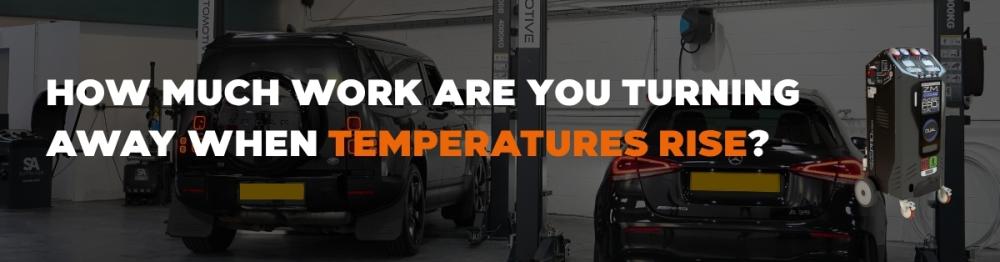
Vehicle A/C servicing
A/C is an obvious place to start because demand becomes much more noticeable once the weather warms up.
If you're only getting the occasional enquiry, continuing to outsource the work may be the sensible option. But if you're regularly telling customers you can't regas or service their A/C system, it's worth looking at what type of vehicles you're actually turning away.
That matters because you don't necessarily need the most expensive A/C machine available.
If you’re getting newer vehicles (using R1234yf) coming in asking for a re-gas, the ZMC-EVOYF Automatic Air Conditioning Station provides a straightforward route into offering the service. It's fully automatic for recovery, recycling and charging, includes a 10kg internal tank and vehicle database, and is hybrid-ready for vehicles fitted with electric compressors.
If your workshop regularly sees a mixture of R134a and R1234yf, a dual-gas setup may make more sense. The ZMC-802 DUAL HI-TECH PRO handles both refrigerants independently within one machine, allowing the workshop to cover a much wider mix of vehicles.
If you're already seeing regular enquiries, speak to our equipment team with an idea of your vehicle mix. We can help you work out which type of A/C machine makes sense before you invest.
Wheel alignment
Wheel alignment is one of the most natural services to consider bringing in-house because the opportunity often comes from work you're already carrying out.
You're replacing tyres and notice uneven wear. You're carrying out steering or suspension repairs. A customer says the vehicle is pulling to one side, or they've recently hit a kerb or pothole.
Those are all situations where checking alignment can become part of the job.
That's why demand for wheel alignment shouldn't only be measured by customers specifically asking for it. If you're already fitting tyres, look at how often your existing tyre and suspension work creates a genuine reason to check the vehicle's alignment.
You’ll soon realise that it’s a profit machine.
Our Supalign 6CCD Wheel Alignment System is a popular computerised aligner we offer. Bluetooth data transmission and rechargeable measuring heads give technicians plenty of freedom around the vehicle, while its database contains more than 90,000 vehicle data sheets and the system can store up to 20,000 customer jobs.
For garages already carrying out alignment using analogue equipment, bringing in a computerised system can also be an upgrade rather than an entirely new service. Measurements are displayed digitally, vehicle specifications are available through the built-in database, and before-and-after results make it much easier to show the customer what was wrong and what has been corrected.
Importantly, bringing wheel alignment in-house does not automatically mean building another dedicated bay. Depending on your existing workshop and lifting equipment, alignment can often be incorporated into the setup you already use. The equipment and available space still need to be checked, but don't assume another bay is required before you've assessed what you've already got.
If you’re still a bit sceptical, we offer wheel alignment demonstrations so you can see the system in action and decide whether it’s the right fit for your workshop before committing.
Book a wheel alignment demonstration
Tyre fitting
Tyre fitting is another service that often presents itself naturally during servicing and MOT preparation.
You find worn tyres, advise the customer they need replacing, and then discover you don't have the equipment to fit them.
The customer leaves, and the tyre sale goes elsewhere.
The good news is that a general repair garage doesn't necessarily need a top-of-the-range tyre changer to start keeping this work in-house. For most everyday passenger and light commercial work, a professional automatic machine with an assist arm will cover a wide range of applications.
The Supalign by Teco SA3500 tyre changer is a sensible example. It's an automatic tyre changer supplied with the HTB21 assist arm as standard, which gives the technician extra control when working with low-profile and run-flat tyres. Rather than recommending several different tyre changers here, this is the type of setup we'd look at first for a general garage bringing tyre fitting in-house.
But the tyre changer is only half of the setup. Once the tyre has been fitted, the wheel still needs balancing before it goes back on the vehicle.
The Supalign Motorised Wheel Balancer 240 Volt complements the tyre changer as a practical general-workshop setup. It handles rims from 10" to 24", has five balancing modes and automatically measures wheel distance and diameter to reduce setup time. It also includes split and hidden-weight functions and a sticky-weight mode for higher-end wheels.
So if you're costing what it would take to bring tyre fitting in-house, don't budget for the tyre changer alone. Consider the tyre changer, wheel balancer, compressed-air requirements, accessories and the space needed to operate them properly.
If you're regularly dealing with specialist wheels or particularly high volumes of run-flat and low-profile tyres, a higher-spec setup may make sense. But for a general garage, there's little benefit in over-specifying the equipment before the workload requires it.
Speak to our tyre equipment team about a complete tyre fitting setup

ADAS calibration
ADAS is one service where we'd be particularly careful about saying every garage should bring it in-house. The investment, available space, technician knowledge and volume of calibration work all need to make sense first.
The best place to start is with the jobs you're already doing.
Wheel alignment, suspension work, windscreen replacement and certain body repairs can all lead to situations where an ADAS calibration is required, depending on the vehicle and repair.
If you're regularly completing the repair but then having to send the vehicle elsewhere before it can be handed back to the customer, start recording how often that happens.
If the numbers begin to stack up, the Supalign TEXA Digital ADAS Master Voice provides a multi-brand workshop solution for bringing calibration in-house.
One of its biggest practical advantages is the digital setup. Rather than storing and manually changing a large collection of individual calibration targets, the RCCS 3 EVO uses a 75" 4K display to digitally reproduce the required targets for camera and radar calibration.
That means less physical target storage and an easier transition between different vehicle applications. The system also includes self-centring wheel clamps for 13"–24" wheels, TEXA diagnostic hardware, guided calibration procedures, three years of software updates and three years of technical support.
That doesn't automatically make ADAS calibration a worthwhile investment for every garage.
The question to ask is:
"How often are vehicles already leaving our workshop because ADAS calibration is the one part of the job we can't complete?"
If that's happening regularly, bringing calibration in-house is worth properly investigating.
Enquire about the Supalign TEXA Digital ADAS Master Voice
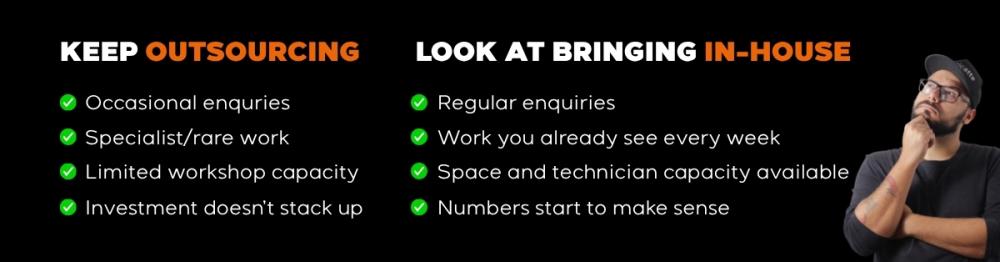
So when does outsourcing stop making sense?
There isn't a magic number that applies to every garage.
Instead, track the work you're sending elsewhere for the next 8-12 weeks. Record the type of job, how frequently it occurs, what you could realistically charge for completing it and how much technician time it would take.
Don't only look at the value of the individual outsourced job either. Consider whether other work is potentially leaving with the customer. If they have to visit another garage for an A/C regas, tyre fitting or alignment, that business now has an opportunity to service, inspect or repair the same vehicle.
Then compare that potential work with the full cost of bringing the service in-house, including the equipment, consumables, training, servicing and workshop capacity required.
One simple calculation can give you a useful starting point:
Realistic number of jobs × expected gross contribution per job
The answer might still be to keep outsourcing the work, and that's fine. The point isn't to find an excuse to buy another machine. It's to find out whether outsourcing still makes commercial sense now that your workload has changed.
Don't buy equipment because you think there should be demand
A machine doesn't become profitable simply because you're able to charge customers to use it. It becomes profitable when there's enough work to keep it productive.
That's why the best place to start is your own workshop.
Look through the last few months of jobs. Ask your technicians what they're regularly referring elsewhere. Think about the customer enquiries you're having to decline.
If A/C servicing, alignment, tyres, MOT testing or ADAS calibration keeps appearing, start putting numbers against it.
You may discover that your next revenue stream doesn't need a marketing campaign to create demand. The customers are already coming through the door.
Want to know whether bringing the work in-house stacks up?
If you've identified a service you're regularly outsourcing, bring the numbers to us.
Tell our equipment team what you're sending elsewhere, roughly how often it's happening and what equipment and space you already have. We can then help you work backwards from the actual workload and find a setup that makes sense for your garage.
Finance is available through our finance partner, subject to status and lender approval. We can also support equipment installation through our nationwide engineering team, with aftersales support available once the equipment is in use. Speak to the JHM Butt equipment team.
Frequently Asked Questions
Which garage services are worth bringing in-house?
A/C servicing, wheel alignment, tyre fitting and ADAS calibration can all make sense when there's enough recurring demand, suitable workshop capacity and technicians available to carry out the work. The best opportunity will be different for every garage.
How do I know whether new garage equipment will pay for itself?
Start by tracking the relevant work you're currently outsourcing. Compare realistic job volume and gross contribution with the cost of equipment, consumables, servicing, training and the workshop time required to provide the service.
Should a garage offer both R134a and R1234yf A/C servicing?
It depends on the vehicles you're seeing. If your workload includes both refrigerants regularly, covering both may make commercial sense. If most of the work is R1234yf, a dedicated machine could be enough. Your actual vehicle mix should drive the decision.
What tyre changer does a general garage need?
For general tyre fitting, an automatic machine with an assist arm can provide a good starting point. Workshops regularly dealing with low-profile tyres, run-flats and premium wheels may benefit from moving towards leverless equipment, while higher-volume tyre bays may prioritise heavier construction and greater control.
Should every garage invest in ADAS calibration equipment?
No. Look at how often your existing repair work creates a calibration requirement first. Technician capability, available workspace and the number of calibrations you're currently outsourcing should all be considered before investing.
You don't need the highest-spec tyre changer simply because it's available. You need one that matches the volume, wheels and tyre profiles you're actually seeing.
Not sure where your workload sits? Speak to our tyre equipment team, and we'll help you compare the options against the work coming through your garage.
September 3, 2026
|
View: 526
|
Categories: Blog
|
By: <a class="mp-info" href="https://www.jhmbuttco.com/blog/author/admin">Admin</a>
About the Author




What are Coil Spring Compressors?
April 21, 2023

Your Full Guide to MOT Ramps
June 6, 2022


The Requirements Needed For an MOT Bay
July 19, 2023

6 Garage Jobs to Prepare For Before Winter Arrives
October 14, 2026

The Garage Jobs Worth Bringing In-House in 2026
September 3, 2026

MOT “Photos at Test” Begins: What Garages Need to Know
August 4, 2026